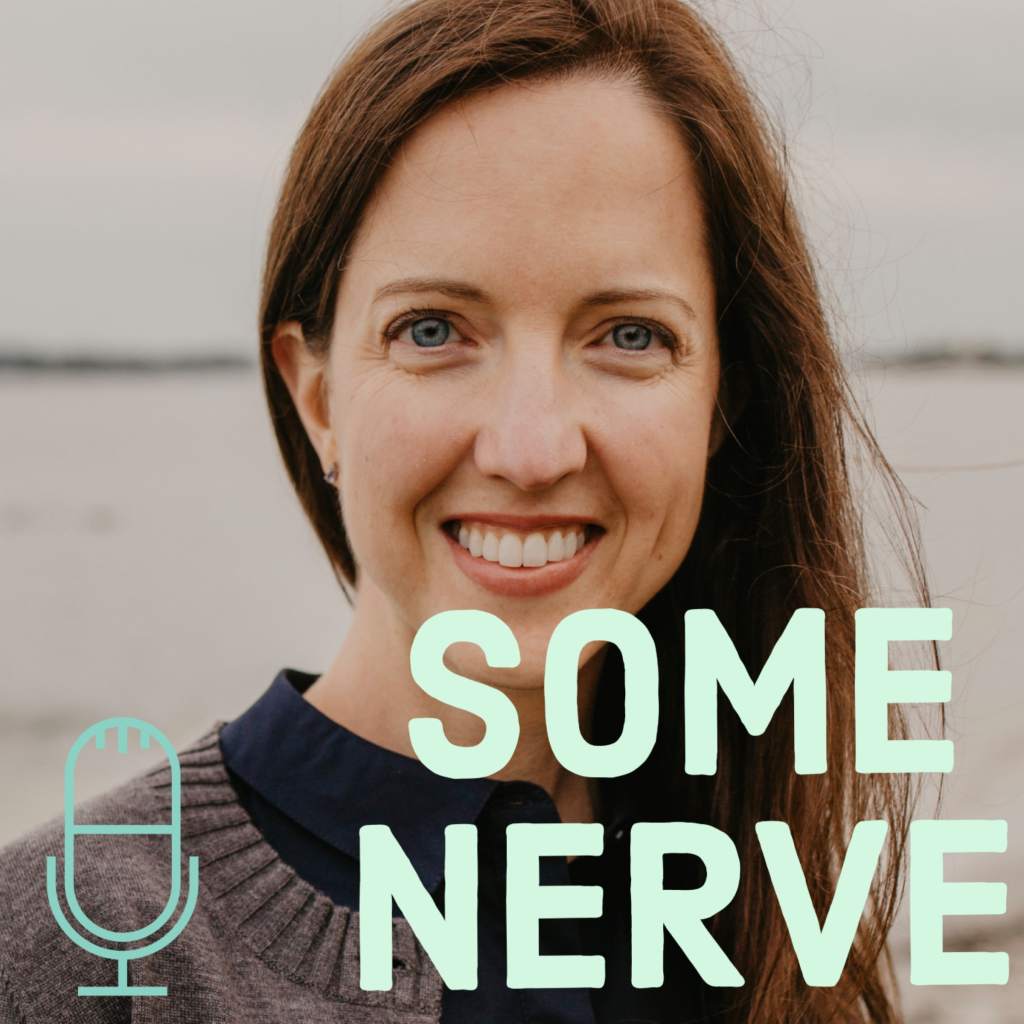
Almost a decade ago, Justine bought a small recording device, which she began using to capture her grandmothers’ stories. Inspired by an assignment in her Medical Anthropology class, and the interviews from Story Corps, Justine jotted down all of the questions she could think of about their families and childhoods. The resulting conversations about the trials and triumphs of her ancestors encouraged Justine to go back to nursing school and to start this podcast.
Grandma Jackie was born the oldest of three daughters in upstate New York in 1925. She became a nurse and the mother to eight children and was married to her spouse Chet for 65 years. She had an excellent sense of humor and although she wasn’t “the cook in the family,” she did host an excellent party and somehow managed to keep her house sparkling clean even with 15 grandkids running around trying to destroy it at all times. Jackie’s mother Edna went to college to become a teacher but quit teaching when she married her husband Edwin. When Edwin lost his job at the bank, Edna went back to school, this time to become a welder and serve the war effort. Jackie and her sisters helped out around the house, but Jackie had clear ideas of who really helped and who didn’t.
Grandma Louise was born the youngest of eight children in Maryland but quickly moved with her family to south Florida, where she lived, as she recalls, without shoes much of the time. Unlike Jackie’s mother Edna, Louise’s mother Elizabeth did not go to college and in fact only was able to complete the eighth grade. Her parents removed her from school so that she could get a job as a laundress to help pay for her siblings to go to school. Her sister Mary was even able to keep taking piano lessons during this time, which hurt Elizabeth’s relationship with both her older sister and her mother. Louise had three children and became a teacher of English and Spanish. She loved to travel and often did so with her second husband, Arnold.
Both of my grandmothers had college degrees, and I didn’t understand while growing up how rare this was, until I talked to them about their siblings, friends, and parents. They were also both raised Catholic and raised their children Catholic; as a result, I was surprised to discover in my teen years that not everyone in Georgia was Catholic and indeed few were compared to Protestant faiths. My grandmothers had lived in almost the farthest north and south you can live on the east coast, respectively, until they both moved to Atlanta in adulthood when their husbands took jobs there.
Show Notes:
- The book I mentioned, It Didn’t Start with You: How Inherited Family Trauma Shapes Who We Are and How to End the Cycle, is linked here (an affiliate on Bookshop.org)
- Brown v Board of Education happened in 1954, but a decade later Martin Luther King Jr wrote about how little had happened. At that point in 1964, 98% of black students still attended segregated schools (his words were republished by The Atlantic).
- You can also read about the current issue of merit-based scholarships going more to white students here
- I hope it doesn’t come off that I am picking on my grandmother’s university, Barry. When she attended school there, it was known as Barry College for Women, and although I can’t be 100% certain there were no black students at the time she attended, a picture of graduation from that period on the history section of their website is a sea of white faces. Fortunately, they now celebrate their history as a Dominican order of nuns and have a population of nearly 80 percent people of color.
- How to end the cycle of trauma, by Mark Wolynn, with help from my grandmothers, Jackie and Louise:
- Keep a daily journal, and use the writing exercises in It Didn’t Start with You to figure out what your core language map is and which descriptors may have been borrowed from past family trauma.
- Although through epigenetics we are learning it’s true that your DNA can be altered by trauma, we also know that there are mediators like journaling, meditation, and daily walks that can improve the way your DNA functions.
- If you’re able to talk with family and in therapy about your past trauma, you can thank your ancestors for their heirlooms and the legacy they passed on. Letting go of their grief and loss will in turn benefit your relationships, setting you free instead of miring you in a sense of unfinished business.
Some Nerve is a weekly podcast for people who have the nerve to show up, talk about hard things that matter, and share our secrets. On Some Nerve, we discuss all the stuff your grandmother wouldn’t have wanted you to talk about at her bridge party. Topics will include whatever makes us feel human, like mental health, grief, trust, boundaries, and joy. We hope that understanding each other better will help us build deeper connections in our lives.
Join us every Wednesday!
 Some Nerve: A Podcast